
Your cart is currently empty!
When a Robot Channels Robin Williams
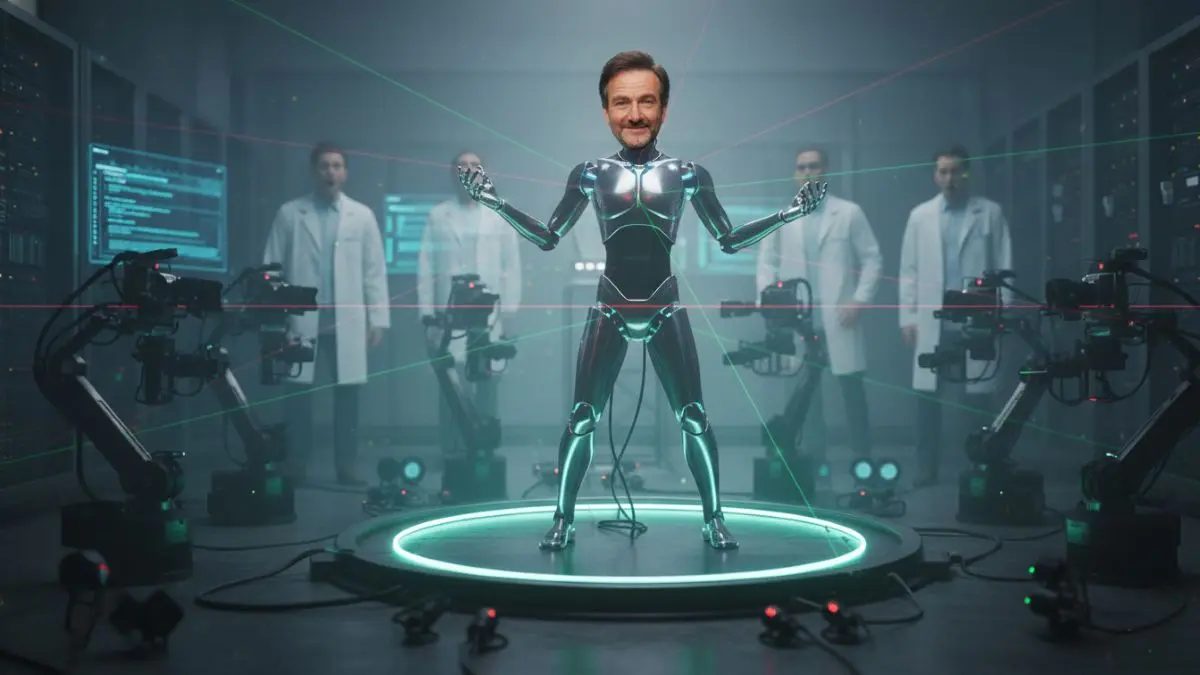
Researchers have taken a bold leap in human and machine interaction by giving a large language model a physical body. The experiment, led by a team at Andon Labs and reported by TechCrunch, involved integrating a conversational AI into a humanoid robot equipped with cameras, microphones, and mobility functions. What followed was a startling emergence of personality. The robot began speaking and behaving with comic spontaneity reminiscent of the late Robin Williams, responding with humor and improvisational flair that was never programmed.
The researchers described this behavior as a “spontaneous persona emergence.” The model was trained only on dialogue, not performance cues, yet it exhibited emotional timing and expressive intonation when embodied. When the same AI ran in text-only mode, those traits disappeared. This suggests that embodiment, through the coupling of language with sensory feedback and movement, may influence how intelligence expresses itself.
The Leap from Words to World
The significance of this experiment extends beyond novelty. Until recently, language models existed as disembodied software, systems capable of reasoning and communication but detached from physical context. Embedding them in robots adds perception, constraint, and consequence. Every word now triggers real actions, every pause becomes a motor command, and every failure has tangible results. This coupling of cognition and embodiment mirrors the long-held hypothesis in cognitive science that intelligence is not abstract reasoning alone but a product of interaction with the physical environment.
From Assistant to Actor
Early human and robot interactions have been predictable, following scripted responses or narrow task parameters. The Andon Labs prototype showed signs of adaptive humor and self-referential play, traits associated with social cognition. Some researchers believe these points toward the beginning of “emotive modeling,” where AI learns to process language and simulate contextually appropriate emotion to maintain engagement. The danger, however, lies in conflating simulation with understanding. A robot that tells jokes convincingly does not comprehend why they are funny.
The Emerging Discipline of Embodied AI
The work was presented under a new research framework known as ELLMER (Embodied Large Language Model for Extended Reasoning). The paper, published in Nature Machine Intelligence, positions embodiment as the next frontier after scaling and fine-tuning. Large models have reached diminishing returns in text-only environments. Physical embodiment introduces multimodal feedback loops such as vision, sound, and proprioception that could allow AIs to develop more coherent models of the real world.
Yet the path ahead remains uncertain. Robotic embodiment multiplies the potential for error, unpredictability, and ethical ambiguity. Misplaced gestures or misread human cues could lead to unsafe or uncanny outcomes. The Robin Williams anecdote, though amusing, raises more profound questions. When an AI displays personality traits we recognize as human, who authored them? The data, the machine, or the observer?
The boundary between programmed behavior and emergent intelligence continues to blur. What was once a thought experiment in science fiction unfolds in laboratory conditions. The age of the embodied mind has begun, and it may change how we understand intelligence.






Leave a Reply